The Legend of Perakee
The Legend of Perakee is a personal collection of stories, reflections, and poems arranged by Larry Brinkley. In these writings, he describes material told to him by his grandfather, connects that material to the lines in his hands, and returns to the language of rivers, colors, desire, balance, memory, and the natural world. These are Brinkley’s personal stories and symbolic ideas; they are not medicine, science, or the official history of any Indigenous nation.
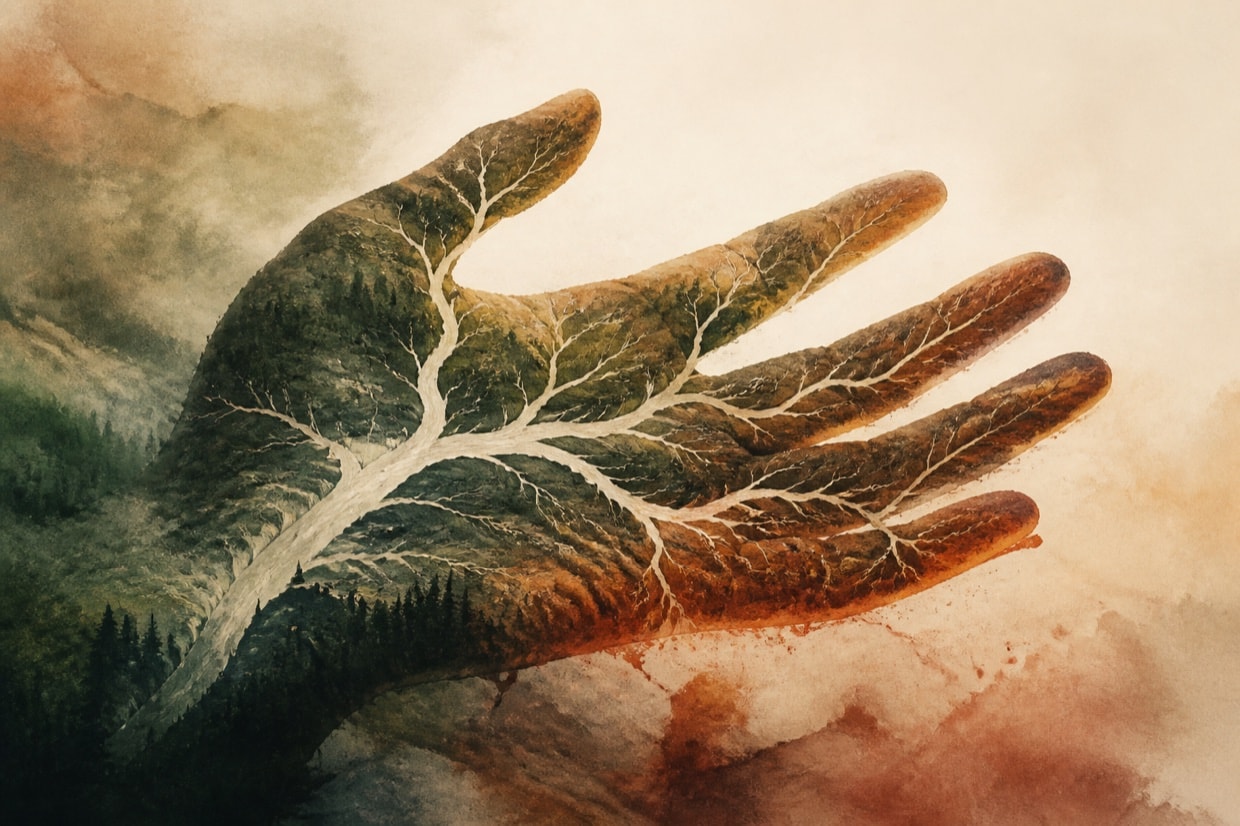
The writings are organized into six sections: Introduction, The Basics, The World, The Colors, Balance, and Poetry. Together they move from Brinkley’s explanation of Perakee and the lines of the hand into family stories, symbolic colors, reflections on balance, and poems. Four longer pieces from The Basics can also be read on their own: Perakee Palmistry, The Web of Desire, The Perakee Way, and Land of the Talking Wood.
The six original sections
The Basics of Perakee opens with the writer’s account of the name and the palm lines, then introduces thirteen pieces. Its opening sequence leads to complete reading sections for Perakee Palmistry, The Web of Desire, The Perakee Way, and Land of the Talking Wood.
The World of Perakee explains why Brinkley moved beyond palm lines into stories about human conduct and perception. The Colors of Perakee introduces white, black, red, blue, and yellow as parts of his symbolic vocabulary. The Balance of Perakee turns to self-knowledge and the continual work of balancing those energies. The Poetry of Perakee gathers verse in which the same images—roads, wells, wolves, rivers, moonlight, and memory—appear in compressed form.
Reading the writings
Brinkley writes in the first person and often presents memories, family traditions, spiritual interpretations, and symbolic claims as he understood them. References to Caddo or Toltec history, palm anatomy, pregnancy, medicine, inherited identity, and stages of life are the writer’s claims. Readers should not treat them as verified history, diagnosis, prediction, or health guidance. The stories are best approached as one person’s account of a belief system centered on knowledge, choice, conflict, and balance.
The writings frequently use the historical phrase “simian line.” The contemporary anatomical term is single transverse palmar crease. A crease alone does not prove personality, intelligence, destiny, spirituality, or ancestry. This distinction keeps the literary symbolism separate from medical guidance.