The Colors of Perakee
The stories of Perakee as told to me and my brother by our grandpa were always filled with colors. He told us of red, blue, and yellow fish that lived in the rivers in our hands when we were very young. As we grew older, the stories grew to encompass our more complicated world, but the colors remained the same.
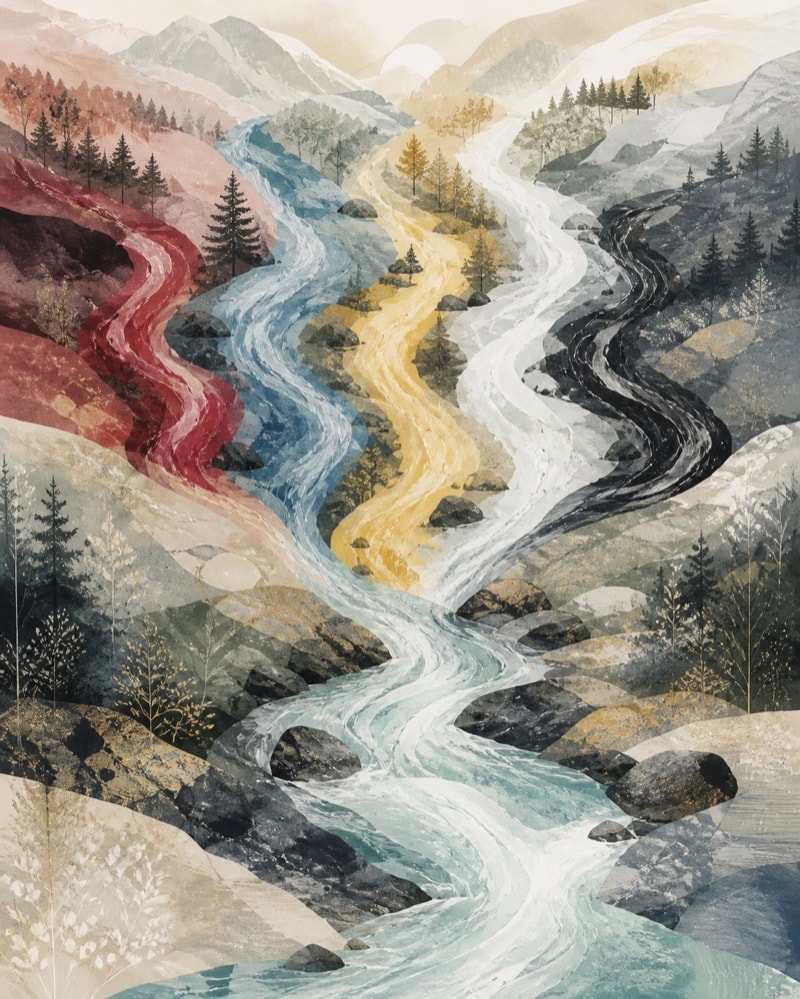
Everything is White, and only changes color when pressure is applied from an outside force. The nature of these forces is what causes the differing hues, and the degree of the force causes the differing shades.
Life force was seen as White, being pure energy that comes from the stars. And it stays White until it is trapped by the Earth, or inanimate objects, which was seen as Black. White is completely free and constantly moving. Black is rigid and immovable. The hues and shades of color were seen as the degrees of interplay between these two extremes—White and Black, energy and objects, life and death, freedom and imprisonment.
This scheme is used throughout the stories of Perakee.
To you who read these stories, it may appear that I was taught them in a linear fashion. But the fact of the matter is each story that I write is gleaned from bits and pieces of stories told to me by my grandpa over the course of twelve years. And intermixed with those bits and pieces of his stories are bits and pieces of knowledge and wisdom that I have gained in the thirty years of living since I was told the stories.
The actual words of the stories are not important. All that is important is the understanding that the words are used to portray. The words I use to tell the stories are different from the words you use to gain understanding within yourself, and even those words will be different from the words you will use when it comes time to teach your own children this understanding.
Also, on a separate note, I am jumping around all over the place in the telling of these stories. I may wake in the middle of the night and remember something that was said in connection to a story, and go back and insert information into stories that appear to have already been finished, hopefully to make the flow better or create a better understanding.
In other words, this is a work in progress, and being constantly edited. I work on this site almost every day. But just because there is nothing new added to the last story, doesn’t mean that nothing has been changed. And I have not figured out how to let you know where the changes have occurred on a daily basis. I apologize to those of you who are trying to follow my musings.
Contents
- The Children of Perakee
- The Toltec World
- The Races of Man
- The Yellow Race
- The Blue Race
- The Red Race
- Black Hearted Men
- A Living Tapestry
- The Races of the World
- Utopia
- The Herd
- Perakee Paradigm
- Color String Theory
The Children of Perakee
According to my grandpa, the villagers of the Bo Tribe did not have much actual contact with the Toltecs. The two peoples were separated by a vastness, much like the people of New York City are separated from the Inuit peoples of the Arctic Circle. They simply did not have much in common.
Until the arrival of Taloh and the twenty-one Perakee that accompanied him, the worlds of the Bo Tribe and the Toltecs seldom crossed, and then only in superficial ways. And when they did show up, it was usually to take the Perakee babies that had been born into the tribe. There was much crying and wailing when this happened. All children were precious. The parents were never told why the children were taken. And it had happened for many generations before the villagers came to understand that it was only babies born with the Simian lines in both hands that were taken.
Few Perakee were born into the tribe, and most of them died before the age of five. They were weak children, often disabled, and could not stand much physical strain; most died in the harshness of winter. Though they were much loved by the tribe, there was a sadness when one was born. The villagers knew that there was not much hope of them being healthy, and if they did manage to live for five winters, they knew the Toltecs would come and take them away.
There was no doubt that Perakee babies were special. The ones born healthy were amazingly fast learners. As they learned to talk, they seemed to be filled with a wisdom beyond their years. They seemed to always want to please the adults. All that was needed to teach them right from wrong was softly spoken words of encouragement or discouragement. Other children seemed to shrug off adversity with impunity. But if an adult even so much as raised his voice in disapproval, a Perakee child seemed to retreat inside himself. And if the child was mistreated and abused, he seemed to curl up inside himself, get sick, and die. They seemed to be very frail, indeed.
“If a Perakee child is to have a chance at all of reaching the age of five, he must be surrounded by kind, caring, patient, and loving adults.”
So why did the Toltec Devils come and take away these weak and sickly children? This was a great mystery to the villagers of the Bo Tribe. They never seemed to make the connection between the Perakee children and the Toltec Devils themselves, even though when one was encountered, he always held up his right hand and showed that he, too, was Perakee.
Only after the events surrounding the Legend of Perakee did the villagers learn the truth: the Toltec Devils themselves were the children that had been taken from the tribe at the age of five.
“We have been aware of the people of the Bo for a very long time, and we have protected you in ways that you cannot understand.” — words attributed to Taloh in the Legend
Who were the Toltecs? Where did they take the children taken from the Bo village? What happened to them? Where are they today?