Perakee Palmistry
My grandfather’s father married the youngest daughter of Toh, medicine man and chief of the Bo Tribe of the Caddo Indians of southwest Arkansas. Toh was a Perakee, which means he was born with simian lines in both hands. Knowledge of the lines was given to him by his grandfather, who was a Perakee.
My grandfather was born in 1892, and he had simian lines in both hands. And he was given the knowledge of the lines from Toh. The Bo Tribe was wiped out by smallpox in 1912. Toh was never seen again, and his body was never found. I was born in 1954, with simian lines in both hands, and my grandfather began teaching me when I was five. That was forty-five years ago, and I have never spoken of it till now, even to my wife of thirty-three years. So please bear with me if I appear to be stumbling in my explanation. It is rather difficult to remember conversations verbatim from the time when you have barely learned to walk.
I have tentatively named this knowledge Perakee Palmistry for reference purposes. It is a body of knowledge developed by Simians to be used by Simians. It was given to me incidental to and preparatory to deeper knowledge that a Simian can use to maintain balance in his life. So let’s just say that I am recording here for the purposes of posterity a tradition of an American aboriginal people.
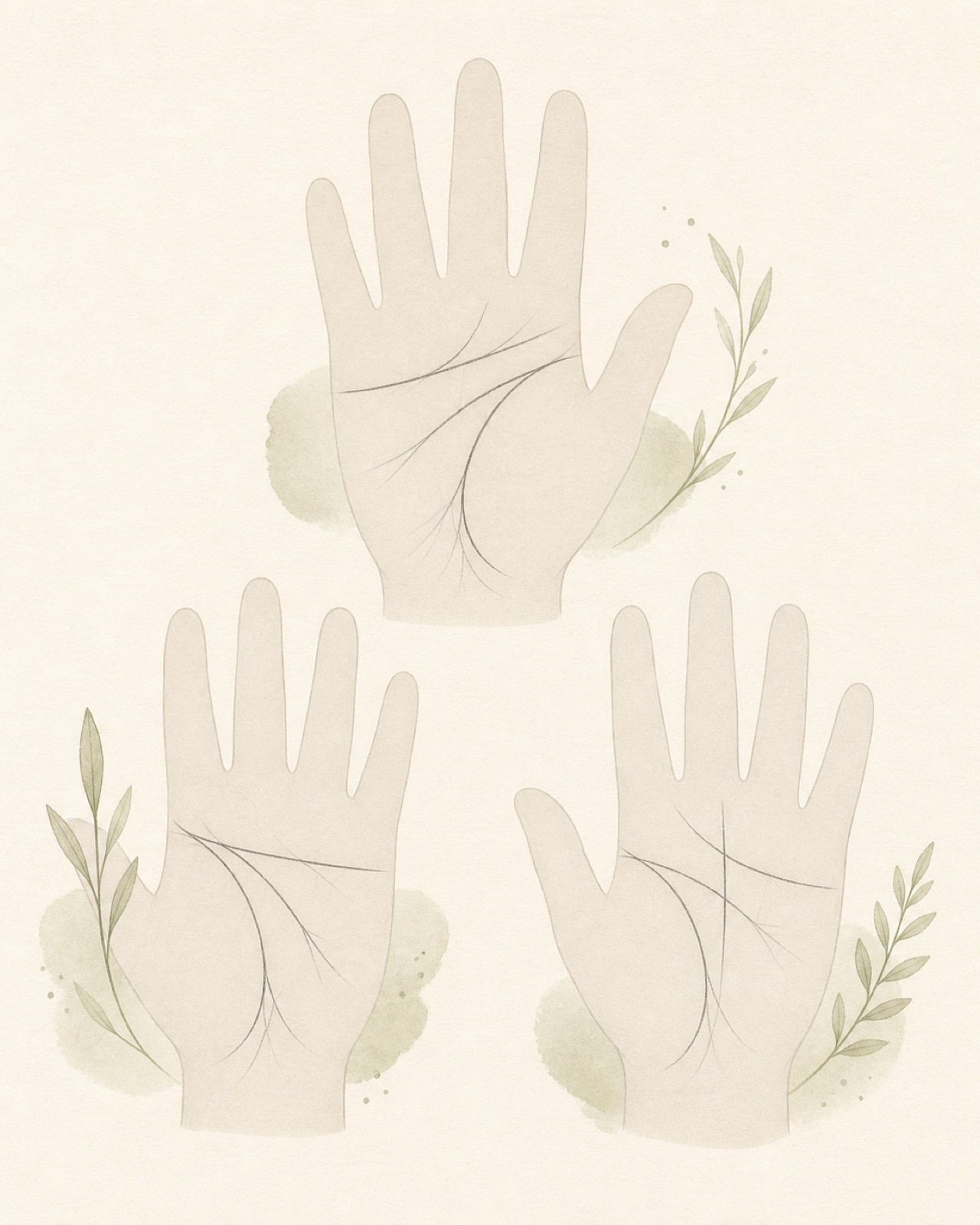
Perakee Palmistry
The side of the palm next to the thumb is called the East. The side toward the fingers is called the North. The outside edge of the palm is the West. And the side toward the wrist is called the South. The lines on the palm show the types of energy we use as humans, and how we use them in our lives.
Our energy comes to us from the Earth, and is shown entering the palm from the East. The energy is split in two upon entering the body, and is shown in the palm as the Earth line and the River.
The path of the energy we do not use in our conscious life, but nevertheless is used by us to sustain our world, is shown as the Earth line as it flows from the River into our body to the South. This line represents the foundation of our world, the rock upon which we live, the cornerstone of all we are and can ever be. It is our physical body. It is what makes us alive, as opposed to being just a dead thing. It is called the Life line by traditional hand analysts.
The River shows the energy we use to be human, as opposed to being just another live thing. It continues to travel west upon entering the body. Within its channel flows all the energies that make up our conscious awareness. The two most powerful of which are the Sun, which is our reason, and the Moon, which is our emotion. Traditional hand analysts call this the Head line.
In a normal human being, the River flows strongly and deeply, in a straight line westward all the way across the palm, all of its energies running smoothly and harmoniously off the edge of the hand and into the afterlife and beyond. All of its energies work together to battle the problems and hardships of life. And because they work together, the River is very, very powerful.
However, this perfect configuration happens in only a very few people. In most people, the energy of the River is split, causing it to lose much of its vitality. Their River does not run as strongly. It travels southward somewhat, and does not have the force to make it all the way across the hand. What happens is the Sun and the Moon cannot work together. The Moon leaves the River and makes its own channel in the North. This is called the Heart line by traditional hand analysts.
The reason the intellect is called the Sun is because, like Sol, it shines with a brilliant radiance and forcefulness all its own. Where reason walks, darkness cannot exist. It can illuminate even the darkest areas in our life. But, like the Moon, emotions cast no light of their own. When hidden from the light of the Sun, the Moon is nothing but darkness. Even emotion’s most positive quality, Love, is but a pale reflection of the need and desire to not be alone. Since the Moon has no life of its own, the channel where it flows is called the Line of Death.
The Moon is always angry and jealous of the Sun, because it knows it can never be as powerful. It is dependent upon the Sun for its energy, so it despises its master and is resentful. The Sun stays in the River, but it has lost much of its power without the Moon. And they are always fighting for control of the person.
A person whose life forces work together in the River is called Perakee, or He Who Speaks With Authority. He sees more clearly and can work more consistently toward his goals because he can direct all he is on the problem at hand.
A person whose life forces are split is called Mahakah, or Perceiver. For him, perception is reality. He takes everything that he sees, hears, smells, tastes, and touches as concrete. But because of all the bickering between the Moon and the Sun, his interpretation of what he senses is often faulty.
In the Perakee tradition, the right hand indicates the patterns at work during the day, and the left hand indicates the patterns at work in the darkness of the day. This is not talking about daytime and nighttime. Day means times when you are in normal awareness, in full control of your faculties. Darkness of the day refers to times when you are being pushed or pulled by circumstances outside your control: when you are asleep, or under trying circumstances, or emotional duress, panic, under the influence of alcohol or drugs, and so on. It refers to times when your unconscious mind takes over.
Neither Perakee nor Mahakah is better or worse. Each has his own flaws. It takes a lifetime to master each one’s own strengths and weaknesses. And they need each other.