Contents Perakee

The Basics of Perakee

Thirteen stories told first to people who, like Larry Brinkley, had looked down at the lines in their hands and wondered about them.
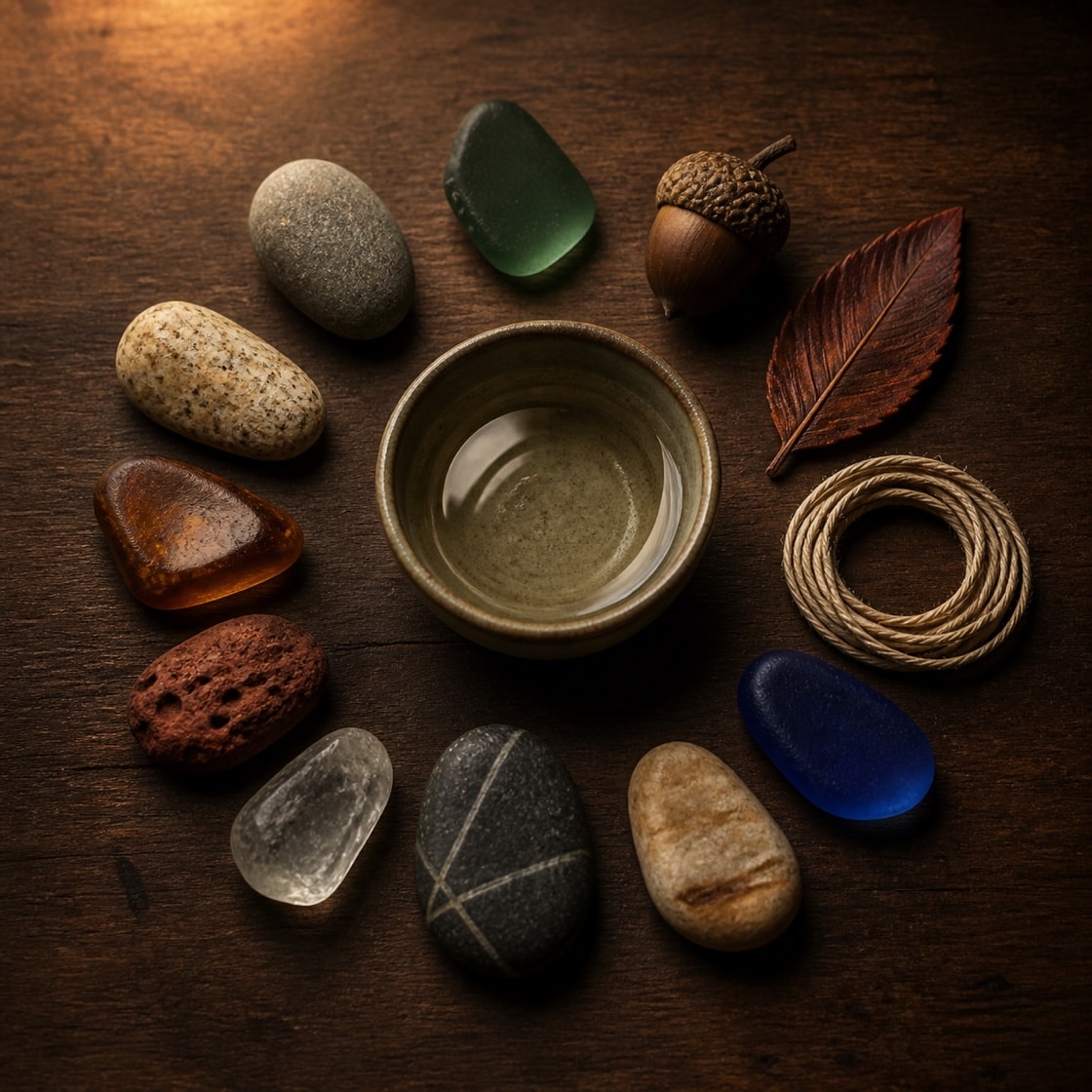
Three fish turn in the current among stones and reeds.

Brinkley first told these stories in order on the Simian Discussion Board. Questions from readers found their way into the telling.

Perakee

“I have told this story to very few people, simply because I am not believed. But I will pass some of it on here, thinking maybe it will help some of you understand what these lines are.”

Larry Brinkley

Larry Brinkley begins with three pairs of hands. There are his own, his grandfather James Bascom Hoover’s, and the hands of Toh, whom Hoover called his grandfather. A line ran straight across each palm. In the family story it gave an old man a reason to sit down with a small boy and a small boy a good reason to pay attention.

Hoover placed Toh among the Bo in southwest Arkansas. He called the people in his telling who carried knowledge of the land Perakee. Some settled arguments, some taught, and some went by the much stranger name of Manwolf. In one tale a traveler raises an open hand. The people waiting on the road look at the line running across it and make room for him to pass. The same meeting finds its way into Brinkley’s song about a lone rider.

Brinkley allowed for the possibility that his grandfather had invented these stories. He also thought he might have been passing on something he had received himself. What Brinkley could vouch for was the telling, the crease and the years he spent trying the stories against his own experience. He took them first into poetry and then to a discussion among other people who had wondered about their hands.

In Brinkley’s words, excerpts for Perakee

I was born with the simian line in both hands. My grandfather, James Bascom Hoover, had the simian line in both hands. His grandfather, my great great grandfather, a man named Toh, had the lines in both hands. Toh was known as a Perakee, which we would call a medicine man, of the Caddo Indians in southwest Arkansas.

I have become a scholar in an effort to ascertain whether this knowledge I have been entrusted is valid, or if my grandfather was full of shit. And I have indeed found that various societies have held those of us with the Simian Lines in high esteem. But I will leave each of you to make those discoveries on your own.

I have become an established poet and songwriter. In this way, I have passed what was taught to me, and some of what I have learned from those teachings, onto the world, though in a somewhat guarded form.

Back to contents ↑

I Walk Alone

A visitor to the discussion might have arrived wanting a single answer about a single crease. Brinkley had grown up with two marked hands and an abundance of answers. His surprise was discovering other people asking questions that had accompanied him since childhood. He knew people with one marked hand, including his fellow writer Calvin McWha. His close example of someone with a crease across both palms was his grandfather.

The two friends had a running joke about diving. In Brinkley’s reckoning most people swam in the top four feet of the ocean. He allowed McWha fifty. McWha gave Brinkley the whole depth and expected him to come back with a pearl. When Brinkley showed up at his house with a poem, McWha knew he had found one. Out came the guitar, and the two set the words to music.

There are two words for people in the family tales. In a Perakee hand the powers travel in one channel. In a Mahakah hand some of them take a separate course. Hoover called Mahakah the Perceiver. Sunlight provides his first comparison. Plants use energy from sunlight to make sugars from water and carbon dioxide, releasing oxygen. In the tale, the old man divides one great Life Force into parts small enough to talk about.

Then comes the problem of growing up with that story. An adult can hail a child as remarkable and still leave him very lonely. The useful gift in the chapter is the time a patient grown-up spends teaching a child how to live with other people. Brinkley means the title quite literally as the title he would give a book about his experiences. Even at the front of a herd, he points out, you still belong to the herd.

In Brinkley’s words, excerpts for I Walk Alone

Having had my simian lines pointed out to me at an early age, what they meant and what they portended, I have lived my whole life with this knowledge. If I were to write a book of my experiences, it would have to be titled, I WALK ALONE. And its underlying theme would have to be: Whether you lead OR follow, you are still just part of the herd!

First I want to say that I am not an expert on simian lines. Other than my grandfather and myself, I have never even met another person with double simian lines, and I am 50 years old. I can only report what was passed to me from my grandfather, and how I have used that information to navigate my world.

My grandfather taught me that there are 2 kinds of people born. They are called Perakee and Mahakah. The difference is represented by the lines in their hands by how they use their life force. He said the life force is just like the Sun.

Back to contents ↑

Perakee Palmistry

Lay a hand palm up. Hoover gives the thumb side a compass direction, calls the edge by the little finger its opposite and makes a landscape between them. The fingers and wrist mark the other two directions. Brinkley tentatively called his grandfather’s way of naming this landscape Perakee Palmistry.

The Earth line swings toward the wrist. It is the foundation underfoot, the share of life that keeps a body in the world. The River crosses the hand and carries what a person can bring to conscious attention. Reason gets the Sun, capable of making something visible in a dark place. Emotion gets the Moon, able to look very different depending on how the light reaches it. The Moon sometimes leaves the River to cut a channel nearer the fingers. These names belong to the tale. Brinkley is quite explicit about how much the people on the two banks need each other.

His grandfather calls the right hand “day” and the left the “darkness of the day.” A person can have plenty of daylight outside and still find themselves in the second condition, startled, dreaming or overtaken by events. This is the difference between setting out to do something and discovering what one does before there is time to think.
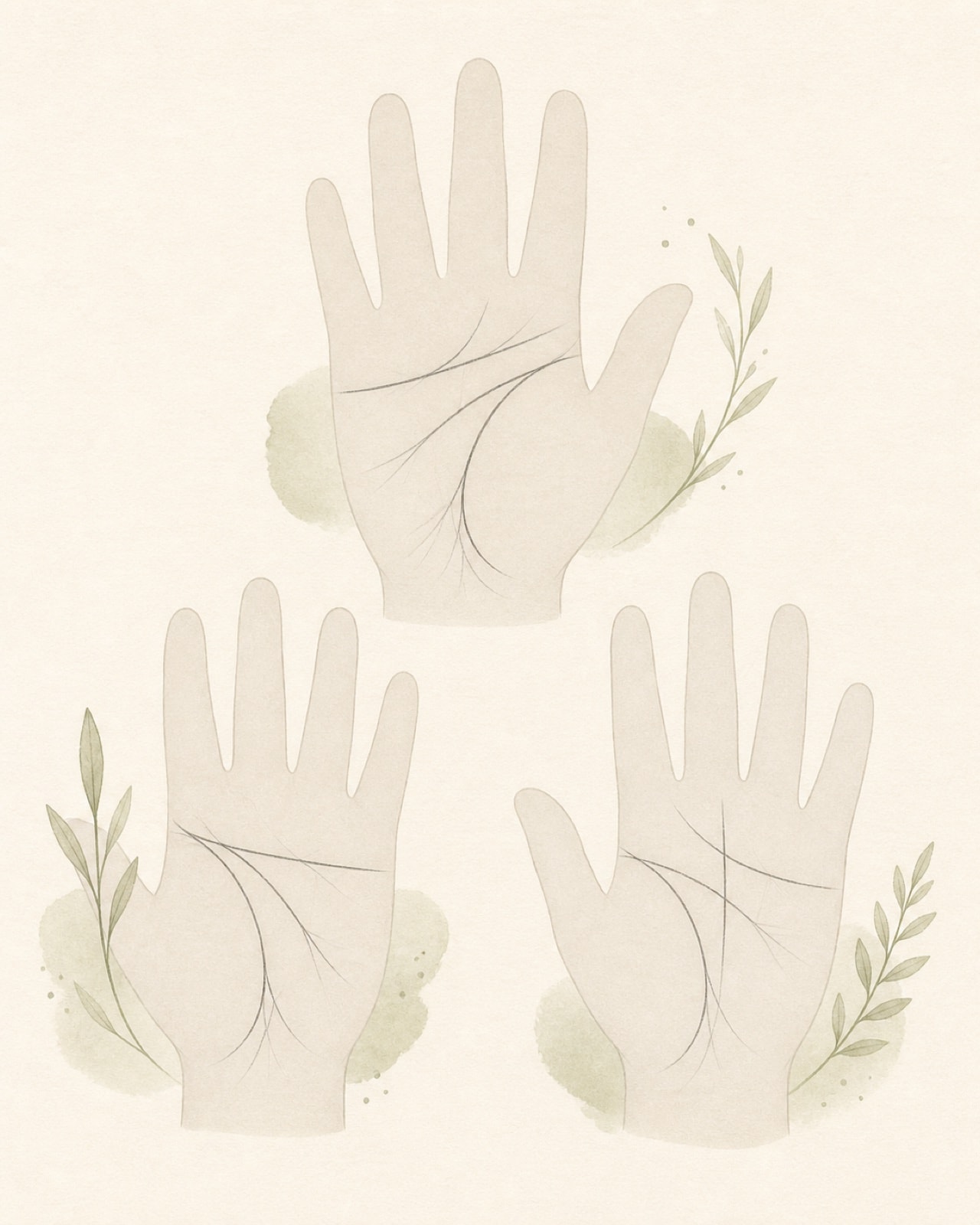
An engraved open hand beside a leaf and a rounded pebble.
Hoover’s compass
East
Thumb
North
Fingers
West
Outer edge
South
Wrist
In Brinkley’s words, excerpts for Perakee Palmistry

The side of the palm next to the thumb is called the East. The side toward the fingers is called the North. The outside edge of the palm is the West. And the side toward the wrist is called the South. The lines on the palm show the types of energy we use as humans, and how we use them in our lives.

Our energy comes to us from the Earth, and is shown entering the palm from the East. The energy is split in two upon entering the body, and is shown in the palm as the Earth line and the River.

The path of the energy we do not use in our conscious life, but nevertheless is used by us to sustain our world, is shown as the Earth line as it flows from the River into our body to the South. This line represents the foundation of our world, the rock upon which we live, the cornerstone of all we are and can ever be. It is our physical body. It is what makes us alive, as opposed to being just a dead thing. (It is called the Life line by traditional hand analysts.)

The River shows the energy we use to be human, as opposed to being just another live thing. It continues to travel west upon entering the body. Within its channel flows all the energies that make up our conscious awareness. The 2 most powerful of which are the Sun, which is our reason, and the Moon, which is our emotion. (Traditional hand analysts call this the Head line.)

The reason the intellect is called the Sun is because, like Sol, it shines with a brilliant radiance and forcefulness all its own. Where reason walks, darkness cannot exist. It can illuminate even the darkest areas in our life. But, like the Moon, emotions cast no light of their own. When hidden from the light of the Sun, the Moon is nothing but darkness. Even emotion's most positive quality, Love, is but a pale reflection of the need and desire to not be alone. Since the Moon has no life of its own, the channel where it flows is called the Line of Death.

A person whose life forces work together in the River is called Perakee, or He Who Speaks With Authority. He sees more clearly and can work more consistently toward his goals because he can direct all he IS on the problem at hand.

In the Perakee tradition, the right hand indicates the patterns at work during the day, and the left hand indicates the patterns at work in the darkness of the day. This is not talking about daytime and nighttime. Day means times when you are in normal awareness, in full control of your faculties. Darkness of the day refers to times when you are being pushed or pulled by circumstances outside your control: when you are asleep, or under trying circumstances, or emotional duress, panic, under the influence of alcohol or drugs, etc. It refers to times when your unconscious mind takes over.

Neither Perakee nor Mahakah is better or worse. Each has his own flaws. It takes a lifetime to master each's own strengths and weaknesses. And they need each other.

Back to contents ↑

Pierce of the Earth Arrow

An arrow from the Earth begins a life in Hoover’s creation story. On reaching the child it divides. One part curves toward the wrist to sustain the body. The other carries the possibilities of thought and feeling out across the palm. Sometimes that second piece holds together. Sometimes it scatters and the Moon makes a channel of its own. The story calls the space between the Sun and Moon a field where they try their strength against one another.

Brinkley uses the arrow to get from a drawing of the hand to a drawing of time. First comes water drawn fresh from a well. A stream goes tumbling down a mountain. A torrent cuts its own course through the ground. Finally there is a river wide enough to carry what it has gathered quietly back toward the sea. “First” and “Last” name two points in one person’s life. A child born tomorrow can start the story all over again. The ages are landmarks in the telling. A crease is a feature of the skin, and the arrow belongs to the legend’s account of beginnings.

In Brinkley’s words, excerpts for Pierce of the Earth Arrow

There are 22 energies flowing in the River which work together to make us human. Some are animal qualities, some are plant qualities, and some are unique to humans alone. Of the uniquely human energies, the 2 most powerful are the Intellect, or Sun qualities, and Emotion, called the Moon qualities. All these energies work together, not always harmoniously, to battle life's problems.

A baby perakee is known as the First of the Perakee, up to the age of five. It does not mean that he is the first Perakee, but that this is the first that the world has seen of a particular Perakee. At this age he is compared to pure water from the well. From the age of five to seventeen, he is compared to a mountain stream, bubbling and laughing as it makes it way down the mountainside. From the age of seventeen to twenty-nine, he is compared to a raging torrent that cuts through the earth, testing its strength against all obstacles, eroding everything in its path to form its own channel. Then after the age of twenty-nine, when he has learned to control his impulses and desires, he is known as the Last of the Perakee. Again, this does not mean that he is the last Perakee that will ever live. It means that this is the last stage of a particular Perakee's life. He is then compared to a wide, lazy river that is slowly moving to the sea, taking with it all the dregs and sediments of life to be cleansed in the waters from which it came.

The farther their lines are apart, the less they will work together, the more they will fight. The area between them is a battlefield. If they are extremely far apart, they are more like two cowards calling each other names--- one afraid to throw the first punch and the other is glad of it!

When there are other lines in the hand, such as what hand analysts call the Fame line, then that indicates that other fragments of the life force are making their bid for power. They may not win, but they add further confusion into a person's life.

Back to contents ↑

The Web of Desire

Toh told his stories among the people of the village, within earshot of anyone who cared to listen. Having a particular hand gave the child in the story a long apprenticeship. It took patience, choice and mistakes to become a wise adult. The storyteller directs our attention to the Earth line because both kinds of hands share it.

Imagine a whole ocean and a person familiar only with the top four feet. There is a depth under the familiar surface which the character ordinarily has little cause to think about. Hoover calls its pull Desire. One want catches another, like threads tightening around an insect. Getting what a person wanted at breakfast need have very little to do with what the same person will want at supper.

The curious turn in the chapter comes with a child learning a color word. Someone points and says red. It takes many such occasions before two people can discuss the same object with confidence. Try to imagine stepping into someone else’s senses with all the familiar labels gone. What would there be to be jealous of in a world one had scarcely begun to see? Brinkley brings the lesson back to the adults pointing things out to a child.

In Brinkley’s words, excerpts for The Web of Desire

According to my grandfather, the word Perakee was synonymous with Medicine Man, Wise One, and Manwolf. These are three distinct classifications. Just having the lines in his hands does not automatically make a child a Medicine Man. It is only after a life long struggle to understand who and what he is, to control the energies he carries, to find the balance and peace within himself that allows Wisdom to flow forth. He was held in awe from the moment of his birth. The people of the village understood that, though he be ignorant and stupid now, the time would come when he would lead, and upon him depend the survival of the village.

The knowledge the Perakee was given was not secret. My grandfather told me that Toh was surrounded by people of his village at all times. He told my grandfather his stories in front of all who wished to listen, and many did. They were free to use the information any way they saw fit.

There is absolutely no difference physically, other than the lines on their hands, between Perakee and Mahakah. You can not pick them out of the crowd by hair color, eye color, musculature, likes and dislikes, personal history, financial status, habits, or any other trait you can name. Neither is more powerful, nor weaker, nor smarter, nor conscientious. They both receive the same amount and type of energies from the earth.

In both Perakee and Mahakah, the part of the Arrow that humans do not use in their every day existence, but nevertheless is used to uphold their world, flows South toward the wrist, and the scar it leaves in its passing is called the Earth line. Twenty-two energies flow through the River, but many times that number flow through the Earth line. No man knows how many it takes to hold our physical world together.

My grandfather told me, as an analogy, that humans use only the top four feet of the water of the ocean. And that all the water beneath is what flows through the Earth line.

The main energy of the Earth line is called Desire. Desire rules not only our world, but the entire earth as well. It is the prime motivating factor behind all that is, ever was, or ever will be. The Great Spirit desired humor in Its life, and told the Earth to make it so. The Earth desired to please the Great Spirit, and so created humans. Now the Great Spirit watches the comings and goings of humans, with our deadly seriousness, and laughs Its ass off!

Desire is what causes us to do anything we do. All our energy is at our beck and call, and we direct it with our Desire. If we desire something, we do whatever it takes to acquire it, to the extent of the strength of that desire. Unfortunately, most of mankind doesn't know what it desires. Their desire changes from moment to moment. And after getting what they desire, they find they are not satisfied. They find that whatever it was, was not what they desired after all. Their Sun and Moon bicker constantly, telling the person to desire more, better, different, faster, slower, prettier, stronger, etc., etc., etc.

Their whole life is like being caught in a giant spider web, one huge web of Desire! People constantly struggle to free themselves from it until they run out of energy and die. All their energy is wasted on pettiness.

Perakee are not free from Desire, either. But, in an effort to counterbalance this strong pull, it is explained to them what it is and how it works. Then at least they are free to choose how to direct their energies.

When a baby is born, it arrives into a world that is totally alien to him. The only constant is his mother. She was with him while he was in the world of the Womb, and she stayed with him throughout his arrival here. She is his only link to his small sense of reality. Her touch, voice, and smell are all that he can even begin to understand. As his senses grow, he begins to feel, hear, taste, smell, and see other things around him. Everything is so strange, he has no idea what they are. But the adults around him help him by telling him what each thing is called. He sees a color, and he is told over and over that that is red, red, red, until he finally understands. Each object has to be identified over and over as he learns to judge depth, size, shape, and utility.

By the time he is five years old, he will have learned to identify literally thousands of things. You and he can discuss any number of objects and agree as to shape, color, texture, size, and usefulness. He has seen these things many times, and he has been told so many times about these things, that there is no doubt in his mind what these things are.

However, if you were to be able to perceive the world through another person's senses and interpret them with his brain, you would not be able to identify a single object in the world around you. The world would be as alien to you as it is to a newborn child.

From this, the young Perakee is taught to feast his eyes upon the beauty, the splendor, the wonder of his world. For it was created just for him the moment he was born, and will cease to exist the moment he dies, never to be repeated again.

According to my grandfather, the extent to which a person understands this one simple lesson, that person will be free from the draining influences of the Web of Desire.

I introduced the lines of the hand and told something about them to, at the very least, offer choices. We can either accept the standard orthodox view of the lines as expounded by modern hand analysts, or be aware that there are other views. My world is NOT black and white. It is filled with all the beauty of the rainbow. I have fought and loved every color under the colorful sun.

Teach your children that. Show them love and patience and kindness and mercy, so that when they go out into the world they will know how to treat others. Help them understand that they, too, are part of the beauty, the splendor, the wonder of this magnificent thing we call life. Lead them on a path of discovery that will so engross them that, when Desire flows so strongly within them that it threatens to pull them into oblivion, they will be too busy with their own path to succumb to temptations. And their eyes will walk on until they, too, become the Last of the Perakee:)

Back to contents ↑

Legend of Perakee

Here is the tale Hoover put behind all the others. In the woods around a village there are occasional glimpses of strangers in long robes. People exchange stories about how someone could have crossed a clearing without being seen. The visitors raise their right hands. Often a visitor arrives in the fifth summer of a particular child’s life and takes the child away. The villagers have many questions about these meetings and very little opportunity to ask them.

One day twenty-two visitors arrive together. The people scatter in alarm. The strangers smile, offer gifts and set out enough food for everyone. A week passes. Their leader, Taloh, explains that their world has come to an end and that everything left of its knowledge lives in the minds of the people sitting there. They have a request. Each will leave a seed for the villagers to plant on his grave. The seeds will become trees. The trees, Taloh promises, can teach people how to listen.

The request concerns a spring that feeds a creek on its way to the Little Missouri River. In the legend it is the Well from which life flows. Taloh tells a terrible story about people killed to keep the place secret and the water reddening in the moonlight. The villagers have to decide what they owe these strangers and what might happen if they turn them away. Their agreement means work that will continue long after the last visitor has died.
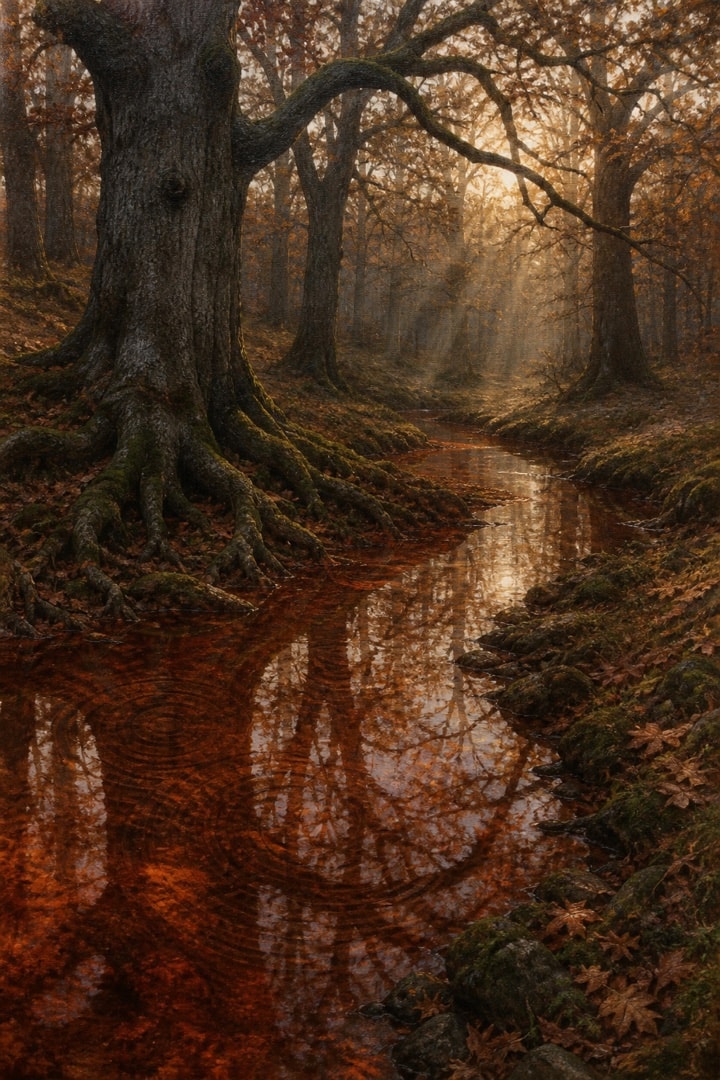
Roots of a large oak reach from a clay bank toward moving water.
Taloh asks the villagers to tend the trees.

Read Land of the Talking Wood

In Brinkley’s words, excerpts for Legend of Perakee

The Legend of Perakee is a body of stories that tell where the Knowledge came from. They have no value in the scientific world of today, other than as myths, and I claim them as nothing more. They are, however, the basis upon which I have lived my life.

The stories handed down by the Bo tribe show that the people of small villages had very little actual contact with the Toltecs. Toltecs were usually seen walking about the prairies and deserts. They wore robes that covered their heads, and seldom did anyone get a look at them up close. In the forests of Arkansas, Toltecs were never seen unless they wished it to be so. The normal day to day activities of the villagers caused them to be in the woods constantly, and no Toltecs were ever reported as being seen. However, someone would look around and suddenly notice one of them standing in the middle of the village. The villagers would surround them in awe, wondering how they could have gotten into the village unseen. Many stories arose about them being shape changers, because sometimes an unusual animal would be spotted just before the Toltec made an appearance, like a wolf or large bat.

When a Toltec was encountered, he would hold up his right hand, palm forward, and everyone could plainly see that they were all Perakee. Almost every time one would appear, it was in the fifth summer that a Perakee baby was born into the tribe. The Toltec would appear, take the baby and leave. No one ever knew how they knew about the babies being in the village, or when they would be five years old. The villagers looked at the Toltecs as magical beings, and honored them accordingly.

As the Toltec Empire collapsed, the villagers heard stories of great battles between different groups of Toltecs. They had no idea what the fighting was about, and, since it did not concern them, could have cared less.

Then one day twenty-two Toltecs showed up in their village all at once. Since they had never seen or heard of more than two Toltecs being seen at the same time, the villagers were very frightened. There was much crying and screaming, and some of them ran away, because they thought the Toltecs were there to kill them for some reason. But the Toltecs only raised their hands and smiled. They scattered among the villagers and mingled with them. They were especially cordial to the children, though none of the children were Perakee at that time. The Toltecs opened their robes and took out various objects and distributed them around as gifts, and enough food to feed to whole village. The gifts and food were strange to the villagers.

Again it took a while for the people to calm down. The Toltecs smiled and helped with chores, and told great stories. Some were silly and amused the children. Some were about things the villagers could not understand. After a week, the leader of the Toltecs, named Taloh, began to tell why they had come.

"We have come on a mission of great importance to the world, a mission of mercy", he said. "We have known of the people of the Bo for a very long time. We have watched you, and in ways that you cannot understand, we have protected you. We know that you are an honorable people, that when you give your word, you never break it. So we have come to you to ask a favor. If you say no, we will understand. But it is to all of our great advantage if you will do this thing for us.

"We are the last of the Toltecs, the Empire is no more. All the knowledge of our race is in our heads. That is why our heads are formed the way they are. If we die, then all our knowledge is gone forever. But we have found a way to preserve it, if you will help us. And in return, we will give all this knowledge to you."

The Bo villagers argued for days about this, some for and many against helping the Toltec devils. Finally they agreed to the Toltecs request. "Thank you", Taloh told them. "Now, each one of us will die, one a day for twenty-two days. The others will bury the dead in the exact spot where their body lies. I will be the last to die, so you will have to bury me exactly as I request. A seed will be planted on each grave. Next spring, twenty-two trees will grow, and in those trees will all our knowledge be contained. Then all you will have to do is talk to the trees and they impart the knowledge."

"We do not know how to talk to trees!", the villagers cried. "What you say is nonsense! How do we learn to talk to trees!?!"

And Taloh replied, "The trees will teach you how to talk to them, in return for your kindness in taking care of them."

Bewildered, some of the villagers asked, "Why do you do this? Why do you do it here in our land?"

Taloh explained, "The water from the spring in your village flows into a creek that flows to the river (now known as the Little Missouri River). Not far from here is a place where the water changes colors on the middle night of the full moon."

"We discovered in that place long ago a treasure that is more valuable than all the wealth of Man. We call it the Well. It is the place where all Life Force comes out of the Earth and flows all over the everywhere. It is this energy that makes Life. It is used by all plants, insects, animals, and Man to live."

For the next twenty-two days a Toltec laid down and died and was buried and a tree planted on his grave. The villagers buried Taloh, then they tended to the graves as they were asked. The next spring twenty-two trees began to grow. The Bo village tended those trees for five generations, over 100 years. They grew taller than all other trees in the area. The whole village could stand under one of them!

Then one night a storm blew them all down. When the villagers went to look at the trees the next morning, they felt lost and afraid. Their mission in life was gone. And they thought the old Toltecs would rise out of the ground and slay them for allowing the trees to die. But suddenly the sky turned a strange color. They looked up and saw the biggest rainbow they had ever seen. It covered the entire sky, and appeared so low that you could have thrown a rock and hit it. So clearly could they see it they not only saw the seven normal colors of a rainbow, but all the myriad colors in between. They counted 21 distinct colors. With white on the top and black on the bottom, they recognized 23 individual shades! And as rainbows had long been seen as good omens, the villagers knew that the Toltecs were telling them that all was OK.

Shortly afterward, a Perakee baby was born into the tribe, the first one since the ancient Toltecs were buried. Then another, and then another! Twenty-two Perakee babies were born into the tribe within the year after the trees blew down! The villagers were ecstatic, but confused. No one knew how to raise a Perakee baby. Always before, at least according to the old stories, the Toltecs came and took Perakee babies away when they were five years old. So, what did this mean? They had no idea.

So they raised the babies as they would normal Mahakah babies. All went well until the babies were five years old. When the babies were old enough to talk among themselves, they found that what the Mahakah adults were telling them about the world around them was NOT what they were seeing. Always before, a Perakee baby had no point of reference, no other Perakee around to discuss or reinforce what he was seeing and feeling. Now, however, there were. And soon the babies were teaching the adults!

And from this it became clear why Toltecs collected Perakee babies. As the Perakee grew, word of their vast knowledge was passed from village to village. Soon other villages were bringing their Perakee babies to the Bo tribe to be raised. The parents, and sometimes the whole village, came along too and were welcomed. For the first time, at least in the Bo village, Perakee babies were being taught by older Perakee. As the Perakee reached the age of seventeen, they began to leave home to find other villages to aid with their knowledge. One stayed behind to raise more Perakee babies, and to lead the tribe.

As the Perakee came across others born with the mark of Perakee in their hands, they taught them all they knew, and then moved on. If the young Perakee were successful in balancing their energies, after the age of twenty-nine, they would hear a distant voice calling their name. And many found their way to this area.

From that day to this, the area around where the Bo tribe lived is known as the Land of the Talking Wood. Within this area is the Graveyard of the ancient Toltecs, alongside the Creek Where the Water Runs Red.

Now you know as much about the origins of Perakee as I do.

Back to contents ↑

Balancing the Level

In the legend, twenty-two Perakee children are born within a year of the trees falling. As they grow, they can compare what they see in a way one child living alone among adults never could. When Brinkley says “the Perakee” in the chapters that follow, he often means those particular children grown older.

Their picture of the world has reservoirs under the ground. Each sort of living thing draws from a Well. A creature comes to it with a Cup, dips at one spot and carries away its own measure of Water. At the end of a life the water goes back carrying something of what happened on the journey. In the grandfather’s account the yellow trace in the water stands for what earlier lives have learned. A cup can get chipped. Its owner owes something to the people who will draw from the same source.

At first, someone else has to care for the child and name sounds, textures and colors. At five the storytelling in earnest begins. From then until seventeen the child has time to learn what to do with an angry feeling, how to be a neighbor, how to put a strong wish into words. At seventeen the young adult starts making a channel of their own. At twenty-nine the question turns outward. What difference does this person’s presence make to the next person who comes to the water?

In Brinkley’s words, excerpts for Balancing the Level

As they matured, they found that what the Mahakah adults were telling them about the world was not what they were seeing. From discussing this problem among themselves, they were able to reinforce descriptions of what they were sensing. All the knowledge of Perakee stems from that period. So from here on, I will preface what I say with "the Perakee", referring to the original twenty-two Perakee. I think this will be less redundant, easier to type, and easier to follow than prefacing everything with "my grandfather told me that his grandfather told him". I hope that makes sense.

The Perakee perceived the Life Force as being like water. Water is held in vast reservoirs within the Earth, and rises to the surface in springs, or Wells. Each type of life, whether plant, insect, bird, animal, fish or human, has an overall Well. Each tribe or species has its own smaller Well. Each baby, whether plant or animal, receives its own Water at the moment of the Pierce of the Earth Arrow when it comes to life. The Water is held in a vessel, or Cup, provided by the Earth. Not all Cups are the same size, so each draws its own amount. Not all Cups are made perfect. But each individual is forced to make do with whatever he is given. And each individual is different because of where he draws his Water from within the Well--- middle, sides, top, or bottom. As Water is drunk from the Cup, it is automatically refilled from the Well.

The Perakee perceived this Water from the Well as almost pure. Though most of the impurities have been removed from it through the Earth's natural cleansing process, there are still bits of alien matter. This foreign substance was perceived as being yellow in color, and could be called Instinct, Racial Memory, or Intuition left over from when other lives used it. The Water is never wasted, but used over and over. As each individual gets done with it, it is poured back into the Well, adding what he learned to the reservoir.

The Perakee perceived that there are four stages in the life of a Perakee, but only three stages in the life of Mahakah. The first stage is from birth to the age of five, and is the same for both Perakee and Mahakah. The child has only to live, to grow and learn how to use his energies. He is mostly guided by Instinct, or what the Perakee perceived as the Yellow energies, during this stage. He must be protected and nurtured. And as he learns to perceive color, size, shape, sound, taste, smell, and feeling, names are given to the baby for each of them so he will be able to communicate what he senses as he lives his life.

At the age of five, the differences between Perakee and Mahakah began to show, though not readily apparent at first. During this stage, the person's other two great groups of energy begin to take over his life. The Emotion group, perceived as the Red, or Moon, energies is one group. The Reason group, perceived as Blue, or Sun, energies is the other.

There is a vast difference between discipline and punishment. Discipline involves patience, love, understanding, and instruction. Punishment involves anger, yelling, implied disappointment, negative reinforcement, and pain.

In Mahakah, the Emotions and Intellect are kept apart, and rightly so. This creates a balancing of forces within the individual. If one threatens to take over completely, then the other steps in and, hopefully, talks some sense into the errant energy. Everything is OK as long as neither energy takes total control.

Perakee, those born with Simian lines, are a different matter altogether. Their Sun and Moon energies, Intellect and Emotion, are not separated by a natural process. Therefor, they must learn to control their energies by an act of Will. The Perakee perceived this to be a great Trust of the Earth, rather than a gift. They must learn to balance the level of intensity between Sun and Moon on their own.

At the age of seventeen, the instincts again take over and humans enter their third stage of life. Like a bird feeling the powerful drive to leave the nest and fly on its own, children go into the World to experience life without their parents and teachers to guide them. This is the second most critical stage for Perakee. They have exactly twelve years to prove to the world-at-large that they can indeed control their energies in an acceptable fashion. During this period, young adults are given some leeway in the performance of their tasks, though certainly not as much as when they were children. The difference is now society administers discipline, instead of parents.

The Perakee, however, perceived that those born with Simian lines have other work to do. By the time they are twenty-nine years old, they should be able to control their Emotion energies, and get on with the task they agreed to perform before they were born. No one can tell you what that task is. Only you and the Spirit were there when the agreement was made.

The Perakee called this task that we are born to perform Balancing the Level. They saw that as entities use and reuse the Water from the Well, it becomes filled with impurities. The Earth does much to help filter these out, but It expects us to help maintain the Wells, just like we are expected to maintain our own Cups. If the Water gets too polluted, it becomes unfit for consumption, and those who drink from the Well die out.

Back to contents ↑

Sleeping With the Enemy

Hoover’s personifications now have a domestic difficulty. A truce is possible between two villages whose borders touch. What does a truce look like when the former enemies have to spend every night under one roof? That is the problem of Sun and Moon in the Perakee household. Each has seven powers. Either one can silence the other and call that silence peace.

The storyteller lays out a fork in the road. A Watcher takes the Black way, carried along while one side decides everything. The Red way belongs to a Guardian, the Blue to a teacher and the Yellow to someone who attends to instinct and wisdom. One narrow White way is scarcely traveled at all. Brinkley knew little about it and says so. These are possibilities in the tale, each with a cost to the traveler.

The story has an answer for anyone who says that an intention is a private matter with no effect on anyone else. Your horse has eaten somebody’s vegetable garden. Who is going to mend the fence?

In Brinkley’s words, excerpts for Sleeping With the Enemy

The original Perakee saw that there are 4 stages in the life of Perakee: from birth to the age of five, from five to seventeen, from seventeen to the age of twenty-nine, and then the final stage, called the Last of the Perakee. They perceived that the third stage is a great battle that is fought within themselves that lasts for twelve years. The principal combatants are the Sun and Moon energies, what we would call Reason and Emotion. Both sides are evenly matched, having 7 energies each, and no one can tell ahead of time which will win. Both are fighting for control of the individual. The entire rest of the person's life hinges on the outcome of this fight.

These individuals were called Black Perakee, and were known as Watchers. Black was the color assigned to the Earth energies. Just because a person fails to bring his energies under control of the Will does not negate obligations in place when the person was born. The Spirit continues to move through the individual, destiny will be fulfilled, even if he has to be dragged kicking and screaming through the motions. And his only recourse is to sit quietly by and watch as the drama unfolds around him.

But this is no great mystery. Society doesn't care if you buy a horse. But you will be held accountable for that horse's actions. If he tears through a fence and eats your neighbor's vegetable garden, you will have to pay for the damage. If you buy a car, you will be expected to demonstrate that you can control it in a safe, acceptable manner. If you run other motorists off the road, or drive through people's houses at high rates of speed, or drive over people who are walking on the sidewalk, you will be banned from driving. You will then be totally dependent on others for your traveling needs, either public conveyances or the whims of friends and family. This is the exact same thing. You are expected to control your own energies! If you cannot, then society will do it for you! And you will probably not like how they go about it!

On the other hand, you pass the test at age twenty-nine simply by proving that you can control your energies, no different than owning a horse or car. It is that simple. Then the world will welcome you with open arms. They will say, "Good for you! You are one of us now. A little weird, perhaps. Nonetheless, you may come and go as you please!"

The Perakee called this balancing of the energies Sleeping With the Enemy. Mahakah go through this balancing process too, but since the forces are separated, it is like two distinct villages of people learning to get along. In Perakee, the once warring parties must live in the same house. And though they have called a truce, each understands that if the other is pushed past its limits, all hell will break loose again!

The Perakee perceived that as we reach the age of twenty-nine, we reach a fork in the road. The left hand path is the way of the Black Perakee. The right hand path is further divided into four directions. These are the paths of the Red Perakee, Blue Perakee, and Yellow Perakee, and a little tiny path called the Way of the White Perakee, used only once every thousand years.

The four right hand paths of the Last of the Perakee are named by the colors of the groups of energy that make us Human. The Red path is the way of the Moon, and those who walk it are called Manwolves, or Guardians. The Blue path is the way of the Sun, called the Teacher's path, and its followers are called Wise Ones. The Yellow path is the way of the Priest, or Medicine Man, and his work is with the seven energies of Intuition, or racial memory, and the symbol of this path is the Star.

I don't know much about the White Perakee. My grandfather spoke of him in very mysterious tones, as if the one that walks that path is something more than human. White is the color assigned by the Perakee for the Life Force itself.

Back to contents ↑

The Perakee Way

What can a teacher give somebody whose next decision has to be their own? Hoover begins early so a child will have words for things long before those things start pulling hard. When Brinkley sets the lesson down, he thanks readers working in a language other than English. A little irony can go missing between two people who know all the same words.

The sharpest danger in the tale is a decisive victory. If Reason takes over, each new feeling has to account for itself before a tribunal. If Emotion takes over, cleverness goes to work defending whatever the person already wants. The quieter, older voices may return only to find the victor waiting for them. Each loss makes the world a little smaller.

Brinkley recalls the severe odds in his grandfather’s tales as part of their warning. They were a storyteller’s way of putting pressure on a choice. Children and adults have their own prospects and lives. A more interesting question for the tale is what changes when someone learns to hear another voice. One person’s account may make that choice imaginable for someone else.

In Brinkley’s words, excerpts for The Perakee Way

I have noticed that many who read these posts have a primary language other than English. My hat certainly goes off to those folks. It must be extremely difficult to follow our musings in a tongue alien to their own. For English, as I rather imagine other languages do too, has many subtleties, fine drawn distinctions of irony, humor, sarcasm, wit, bitterness, and joy. But what else can you expect from a form of communication that utilizes a predetermined series of squeaks and grunts, and is recorded by stylized scratchings? And many of our words have different meanings. Take the word grandfather, for instance. My dictionary gives three different meanings for that word: 1) A parental father; 2) A forefather; ancestor; 3) Pre-existing condition, as in 'grandfather clause'. I would add another definition to that list: 4) A personification of racial memory or ancestral knowledge.

The Perakee perceived that there are four stages in the life of Perakee. The third stage, from ages 17 to 29, is spoken of as a great battle that rages in the hearts and minds of all men. All religions and philosophies tell of this great battle, in many and varied ways. Only the most astute of Mahakah see this battle as a personal process. Most see it as something that only peripherally concerns them.

The only worthwhile conclusion is for neither Red nor Blue energies to win, but for the individual to bring the fighting energies under control of Will. And there is no one on God's green earth that can tell you how to win this fight. There have been many who have won, and their stories are shining examples that it can be done, like stories in the Bible and other holy works of all times and lands. But every story is different. No two people won their fight just alike.

The Perakee felt that knowledge is the ONLY tool we have to help win this struggle. The younger a person is when he begins learning--- about who and what he is, what the energies are, how they work, what the fight is all about--- the higher his chances of success.

Back to contents ↑

The Boss Energy

Count the colors in Hoover’s scheme. There are seven Red, seven Blue and seven Yellow. White, the Life Force moving through them, brings the number to twenty-two. In one of the two kinds of hands the seven Red qualities have a separate channel. Any one of the seven can take the lead in its channel. Any one of the fourteen remaining qualities can take the lead in the River. That is where Brinkley gets his curious number of ninety-eight possible pairings.

In the single River only one companion can be closest at a time. There are twenty-one ordinary possibilities and the rare case in which White itself takes the lead. The Watcher has a boss who keeps all the other voices down. A more workable arrangement resembles a shop full of people whose jobs differ. A favorite coworker still needs everybody else to turn up. Hovering at the edge of all that arithmetic is an ordinary question about friendship. Which quality do you spend enough time with to know its secrets?

In Brinkley’s words, excerpts for The Boss Energy

The lines on the hand, euphemistically speaking, are channels for the 22 energies that make us human. In Perakee, all the energies flow through the River, or River of Life, the line that hand analysts call the Head line. One of those energies is the Life Force itself, and the Perakee gave it the color White. It imbues all the energies with Life. Therefore it cannot be called a separate energy. Which leaves 21 energies that make us who we are.

In Mahakah, not all 21 energies flow through the River. The energies have been separated. Seven of those energies, called the Emotions, or Red energies, live in a separate channel called the Line of Death. These energies have no Life Force of their own, except indirectly, and are therefore also called the Moon energies.

There are seven energies that live in the River that we would call the Reason. The Perakee called these the Blue energies, or Sun energies, because they have so much Life Force that they shine. Darkness cannot prevail where Reason walks.

There are seven other energies that live in the River called the Yellow energies, which are the Intuitions, or racial memories, or instincts. Though these Yellow energies are an active part of all our lives, they are seldom perceived while the other energies are fighting. I went into some small detail about this fight, which occurs from the ages of 17 to around 29, in earlier posts.

Each line on the hand has an energy that is dominant within that grouping. The dominant energy varies from person to person. In Mahakah, any one of the 7 energies in the Line of Death can rise up to lead the other 6. And of the 14 energies in their River, one will naturally be the leader of those energies. The two Boss energies join together to make the basic personality of each Mahakah. Therefore, there are 98 basic types of Mahakah. There are sometimes other lines in the hand, with one or more energies grouped there, and of course that grouping will have a leader also. But instead of helping, this third, and sometimes fourth and fifth, Boss only adds confusion into the life of the individual. It is hard enough to try to please 2 bosses, much less 3, 4, or 5!

In Perakee, only one energy will be dominant in the life of the individual. Only one CAN be dominant at any one time. Therefore, there are 22 basic types of Perakee, for once every thousand years a person will be born in whom the Life Force itself is the Boss energy.

In Black Perakee, either the Red or Blue energies won the fight, and subjugate all the other energies. This is not necessarily good or bad, but it is perceived as a less than admirable conclusion, because the individual loses a certain amount of personal choice. All the energies will rise once the fighting stops, but the person's entire life will be geared toward either emotional or rational pursuits.

Once the fighting stops, around the age of 29, if neither group has totally dominated the individual, then all 22 energies will have an equal voice. You will have a chance to get to know them, what they are, what they have to offer, their function. Each one has a completely different personality. Some you will like and enjoy their friendship. Some you may not really care for. But just like a company that has 22 employees, who all must work together to turn out the company's products, you allow all the energies to do their part.

Because of your nature and bent, one of those energies will become your best friend. You will do everything together. You will share each other's deepest, darkest secrets. You will become an expert of that energy. And, depending on the color of that energy, you will become Red, Blue, or Yellow Perakee.

Back to contents ↑

Medicine Man

The word “medicine” in this title names a figure in the family stories. Brinkley gives him no diploma and no date of appointment. The Guardian’s and the teacher’s paths can occupy a life. The Yellow path especially calls for a patience that no announcement can supply.

As the quarrel between Sun and Moon dies down, the old wants can lose their urgency. A person who used to have a quick answer finds several coming at once. A friend asks how the day is going and gets a joke. A doctor asking very similar words needs an account of how someone feels. The skill lies in hearing the question the other person actually asked. Some of the twenty-two voices are talkative, some timid. Nobody can coax them all into speaking by the end of a single conversation.

Hoover tells of a distant call that comes when somebody has done the work that belongs to them. What the Earth might have to say at the end of that trail belongs to the person who hears it. The teller stops there. He has already given the reader the images needed to recognize a call in the next story.

In Brinkley’s words, excerpts for Medicine Man

In the posting entitled Balancing the Level, I explained how the original Perakee perceived the Life energies that flow through humans, and that they perceived the task of all Perakee is to help maintain the Wells from which Life Force flows. And I told that that task is performed in two ways. Since then, I have explained the first way that this is done: by simply balancing your energies so that you yourself become a balancing influence in a chaotic world. You don't have to DO anything. Most times, just being in a given situation will prevent the Full Moon from rising in the hearts of those around you.

This process of balancing your energies does not happen overnight. It is a transformation that begins around the age of 29, when the agitation of the Moon and Sun energies is quelled, and may take many years to bring to completion. Several things happen during this phase of your life. As peace begins to reign in your world, you begin to notice energies that were there all along, but you had forgotten all about. I say forgotten, because there was a time in your life when those energies were the dominant force of all you were. Before the age of 5, a child is ruled by the Yellow energies, or Instincts. These energies all but disappear when the battle between the Red and Blue energies begins to rage. When the battle is over, they rise again to be a viable part of your world, and you will recognize them as old friends.

In a real way, you could say that, energetically, you become as a little child again.

Another thing that happens during this phase is: you lose a lot of your drive. Drive is a function of the Red energies, just as Wisdom is a function of the Yellow energies. Drive is the manifestation of Desire in the hearts of men. It is what pushes us to be better, faster, more powerful, acquire more money, have a bigger house, drive a better car, conquer more women, etc., etc. As the Moon grows less demanding, you will find that all the things you thought were so damned important when you were younger just don't matter any more.

A third change that you will probably notice is: it becomes increasingly difficult to answer even the simplest questions. The reason for this is quite simple. Before, there were only 2 answers to every question--- an emotional response or a rational response. Now, as all the energies begin to balance, you find that each has its own understanding. Therefore, you begin to perceive that there are actually 22 answers to every question that you are asked. This can be vastly confusing unless you understand what is going on. Answering every question 22 times is not a very effective form of communication, to say the least.

The Perakee saw this and devised a very simple, but effective, exercise to counteract this confusion. They said, "Never tell a lie, but always veil the truth." They perceived that for true communication to take place, a response must energetically match the question. If a friend asks, "How are you today?", you could answer him humorously, which is a function of the Red energies. But if a doctor asked the same question, he is expecting an answer from the Blue energies.

Some of your energies are bold and talkative, while others are shy and stoic, and take much coaxing to reveal their secrets. Years may pass before they learn to trust you completely. Years may pass before you learn to trust them. Like all things Perakee, it is not an easy task, and most will never get to know ALL the energies. Some will remain Red Perakee, some will progress to the level of the Blue energies. Only a few will make it to the level of Yellow Perakee. The Yellow energies, the Instincts or Racial Memories, are the realm of what in English is called the Medicine Man.

Becoming a Medicine Man is not a personal choice. Life is not a game show. "Let me see… I think I'll choose door number three!" It just does not work that way. It is only after a life of hard work that Wisdom begins to flow. And don't ask me to tell you how to know if you are a Medicine Man. No man can answer that. It is not a title that you bestow upon yourself. You will not be able to say, "Yes, I became a Medicine Man at 12:30am on August 1st, 1932." It just does not happen that way…

My grandpa explained it: "At some point, if you are successful in gathering all your energies into a cohesive whole, you will hear a distant voice calling your name, and you will feel compelled to follow. Death awaits you at the end of that trail, but you will have no choice but to go. It is the Earth calling you home. The Earth itself will remind you of the task you agreed to before you were born. It will teach you all you need to know to complete that task. And what that knowledge is, no man can say."

Back to contents ↑

The Rainbow

White at one end, Black at the other. Between them the grandfather distinguishes twenty-one shades in his scheme. In the sky, a rainbow’s colors blend from one into the next. The children hear about Red, Blue and Yellow in groups long before they hear the name of any one shade. A pebble can be a baby rock and a stream a baby river. Even a drop waiting in a cloud can be given a family and a reason to be afraid of thunder.

Brinkley gets into an argument with his grandfather about what an emotion is. Jealousy or frustration seems like an obvious answer to the boy. Hoover is after the thing that happened just before the feeling. Somebody thwarted a plan or made a person feel small. Naming the impulse creates a little interval in which its owner can consider what to do.

At the far end of the tale the powers can work together as parts of one outfit. Brinkley imagines diving below the shallow layer of the ocean familiar to the swimmer. He calls that imagined uniting of all the colors the Afterlife. Readers of the family stories meet the same rainbow in the sky after the great trees come down.

See all twenty-one shades in The Colors

In Brinkley’s words, excerpts for The Rainbow

The Perakee perceived that the world of humans existed in a very narrow spectrum between Life and Earth. They assigned the color White to represent the Life Force, and the color Black to represent the Earth. They knew full well that within the White, there exist an untold number of energies. And they knew full well that within the Black there exist an untold number of energies. But as far as human perception is concerned, our world exists only between these two colors. The things that exist above the range of human perception simply contain too little Earth to be detected. That does not mean that those things do not exist, but that they live in a world beyond the area normally perceived by humans. This would include things like angels, demons, fairies, etc.

The narrow spectrum of human understanding between Black and White was perceived as having 21 distinct levels.

LIFE FORCE: White

RED ENERGIES: Purple indigo, Purple, Purple red, Red purple, Red, Red orange, Orange red.

YELLOW ENERGIES: Orange, Orange yellow, Yellow orange, Yellow, Yellow green, Green yellow, Green.

BLUE ENERGIES: Green blue, Blue green, Blue, Blue indigo, Indigo blue, Indigo, and Indigo purple.

EARTH ENERGIES: Black

My grandpa believed that everything you can name has some degree of Life Force. He personified everything. And everything was looked at as either a baby or an adult. A twig was a baby tree, a stream was a baby river, a pebble was a baby rock, a Volkswagen was a baby car, and Mahakah was baby Perakee.

He never sat down and enumerated the specific energies. But from stories he told I began to understand what the individual colors represented. Here is an example of one such story: "One of the Blue energies could be called Herd. Everything exists in groups of individuals like itself. Water collects in pools, streams, lakes, and oceans. The reason it does this is because it is frightened to live alone. When baby waterdrops in clouds see a flash of lightning, they become very scared. The thunder you hear after a flash of lightning is all the baby raindrops screaming."

My grandpa always talked about the energies in clumps of Red, Blue, or Yellow. Once he was talking about the Red energies, and he kept using words like Dominance, Battle, and Drive. I told him that those things are not emotions, that emotions were things like jealousy, anger, frustration, happiness.

The Perakee spoke of an ability to rise above or below the area of the 22 energies that make us human. This ability is reached when a person goes beyond the stage of life known as the Medicine Man. This highest, and last stage of all human life, is known as the Afterlife. Afterlife is not necessarily reached after the physical death of humans, though it is most certainly the case in the vast majority of instances. Afterlife is reached when all 22 Energies are melded together. Instead of the Energies acting separately, they become One. Like all the pieces of a scuba diving outfit working together, a person can use them to dive safely below the top four feet of the world's oceans. Or, by putting them together in a different way, soar above the normal spectrum of human existence.

Back to contents ↑

Land of the Talking Wood

The last story brings the speaker back to southwest Arkansas. Hoover told remembered stories about Toh, a village he called Bo and people lost to an epidemic. He described knowledge sometimes passing to someone in another community. Brinkley knew these events through family stories. The living Caddo Nation tells its history in its own voice.

The memories Brinkley can give firsthand start with fishing and walking. His grandfather had a story for whatever his grandsons happened to be watching. A squirrel, a rabbit, a fish in the creek could give the children a way to see Red or Blue at work. They were in no particular hurry to discover what the old man meant. It was enough to spend the day with him.

In one part of the wood the rules changed. They walked in his footprints, single file and quietly. On reaching one of the big oaks the boys had only to stand and listen. An acorn in the old man’s story takes up the knowledge of the person buried underneath it. As a young man Brinkley spent seven years away from home. When he came back he found both the storyteller and the great trees gone. The last part of the quest took him back to a place he had known before he had words for it.

In Brinkley’s words, excerpts for Land of the Talking Wood

He was forever telling stories about all kinds of things. He built his stories out of things that my brother and I could understand, usually about whatever activity we happened to be engaged in at the moment. He told stories about Red fish and Blue fish that lived in the River in our hands if we were fishing.

The only time my grandpa ever became stern with us was when we entered a particular area that he called the Indian Graveyard.

When we grew up in the 50's and 60's the woods in this area were virgin forest. My brother and I only wore shorts, occasionally a T-shirt, and no shoes in summer. There was hardly any undergrowth. Most trees were huge. And there were dozens of tremendously large red oaks that my grandpa called Indian Trees. They were all marked in a particular manner so that you could tell them apart from all other trees. Whenever we came to one of them, we would stand quietly for several minutes. Grandpa would tell us not to talk, not even think about anything, just listen, and the trees would reveal secrets to us. He told us that these were our ancestors. He explained that when a Perakee would die, he would be buried in a place of his choosing, and a red oak acorn would be planted on the grave. The oak would grow, nourished by the Perakee's body, and hold all the knowledge that the Perakee had gained in his lifetime. And that whenever we needed to know anything, all we had to do was come to one of these trees and sit quietly and the tree would speak to us and reveal the answers to our questions.

But my energies did balance, as these posts clearly show. In 1988 I heard the distant voice calling my name. And the Earth has shown me many things. It showed me that the Legend of Perakee is real, and that the ancient Toltecs did indeed find a way. And that their knowledge is available to anyone who can successfully balance their energies.

I have warned that Perakee Palmistry is not an end in itself, but merely a didactic device that leads to deeper knowledge.

The end goal of any system of thought, whether used by Mahakah OR Perakee, is to bring balance into a person's life. Without balance, there is only chaos, and very little productivity. This system works for me. It may or may not work for you. I introduce it merely to offer an alternative to what is already here. It offers you a choice. That's all that most of us really want anyway. We are not lazy, we will do the work, we just need help in understanding what our choices are.

Back to contents ↑